
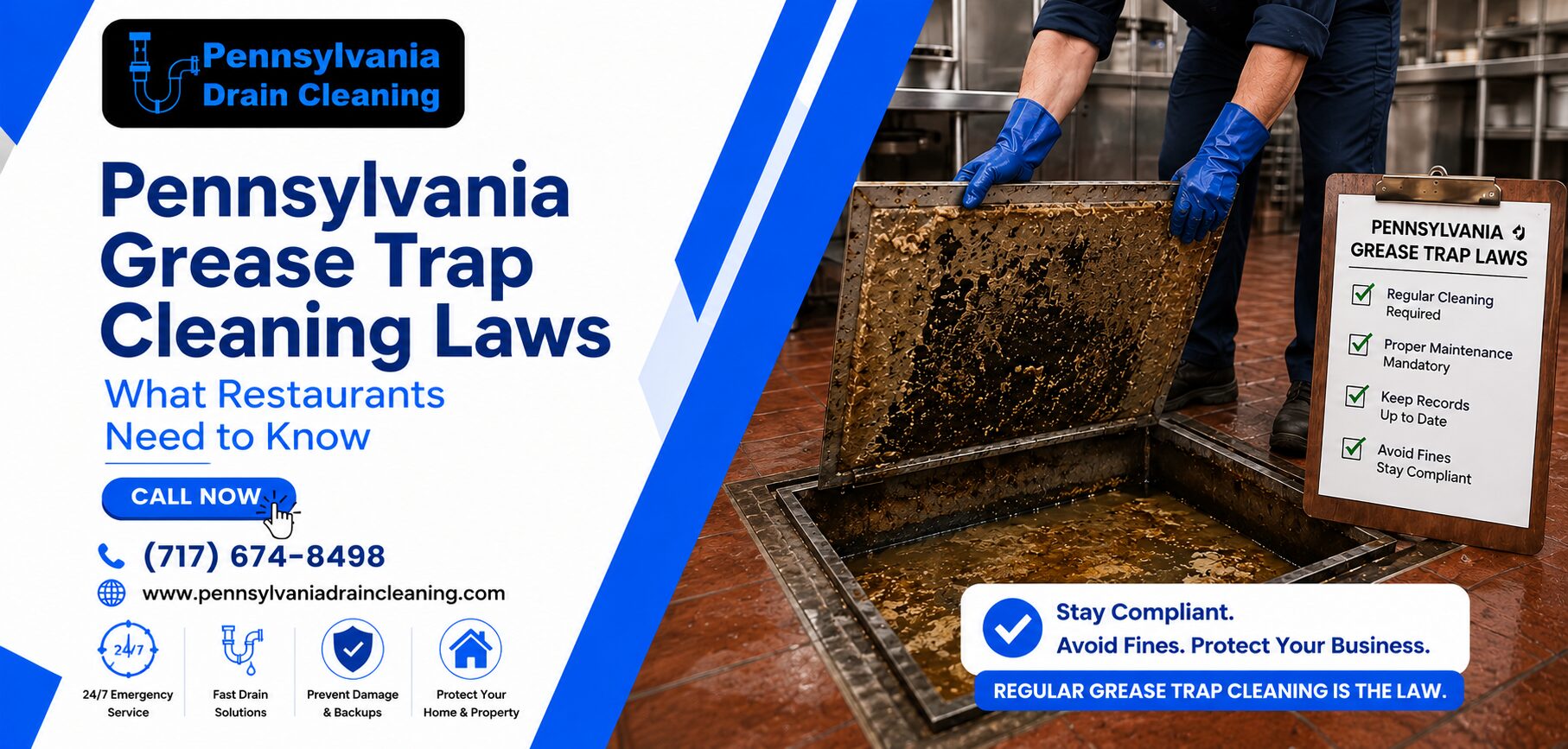
Grease trap cleaning for Pennsylvania restaurants is a legal obligation, not an optional maintenance task. Every food service establishment in the state that discharges wastewater into a municipal sewer system is required to install, maintain, and regularly clean a grease trap or grease interceptor under a combination of federal, state, and local regulations. Failing to meet those requirements exposes restaurant owners to fines, forced repairs, permit revocations, and in serious cases, temporary or permanent closure. Understanding precisely what the law demands, who enforces it, and how often grease trap cleaning must happen is the foundation of running a compliant commercial kitchen in Pennsylvania.
What a Grease Trap Actually Does and Why the Law Requires It
Before getting into legal specifics, it is worth understanding the problem grease traps are designed to solve, because the regulatory framework makes far more sense once you understand what fats, oils, and grease actually do to a sewer system.
When wastewater from a commercial kitchen flows down the drain, it carries dissolved fats, cooking oils, and grease. Those substances are liquid when hot, but as soon as they enter cooler pipes and sewer lines, they begin to solidify and adhere to pipe walls. Over time, this buildup narrows the interior of pipes, restricts flow, and eventually causes complete blockages. Fats, oil, and grease pose a significant threat to sanitary sewer systems by potentially creating blockages in sewer pipes and other infrastructure. A short time after entering the drain, FOG begins to cool and separate, accumulating in drains, sewer pipes, and sewer pump stations, and over time FOG residue builds up, eventually causing blockages that lead to increased maintenance costs, messy and costly overflows or backups, and potential health and environmental hazards.
A grease trap intercepts that contaminated wastewater before it reaches the municipal system. The trap slows the flow of water, allowing lighter FOG material to rise to the surface and be retained in the trap while relatively cleaner water continues to the sewer. A grease interceptor operates on the same principle but at a larger scale, typically installed underground outside the building for high-volume operations.
The U.S. Environmental Protection Agency does not mandate grease traps directly, but the Clean Water Act prohibits fats, oils, and grease from entering municipal wastewater systems in concentrations that cause blockages or treatment disruptions, and cities and counties enforce this federal standard through local ordinances that require food service establishments to install grease removal devices.
In Pennsylvania, that enforcement structure runs from the federal Clean Water Act through the Pennsylvania Department of Environmental Protection down to individual municipal sewer authorities and health departments, each of which carries the authority to inspect, cite, and penalize non-compliant food service establishments.
The Federal Framework Behind Pennsylvania’s FOG Rules
Pennsylvania’s local grease trap ordinances do not exist in isolation. They are built on a federal regulatory foundation that every Pennsylvania restaurant owner should understand, because federal authority ultimately sits behind the fines and enforcement actions that local sewer authorities can bring.
The Clean Water Act requires federal, state, local, industry, and the public to establish pretreatment programs to prohibit the introduction of pollutants into treatment works that are difficult to treat or that may interfere with their operation, and federal regulations specifically prohibit solid or viscous pollutants in amounts which will cause obstruction to the flow in publicly owned treatment works, and this prohibition explicitly includes FOG.
The EPA provides technical guidance but does not prescribe specific device types or sizes, as those are determined by local plumbing codes and sewer ordinances based on regional infrastructure capacity and environmental conditions. This is why grease trap requirements vary from one Pennsylvania municipality to the next, even though the underlying federal prohibition on FOG discharge applies uniformly across the state.
The consequence for willful violations is not limited to administrative fines. Criminal prosecution is reserved for egregious cases involving knowing violations, falsified records, or substantial environmental harm, and the federal government has pursued criminal charges against food processors and institutional kitchens that deliberately bypassed pretreatment equipment or discharged directly to waterways, resulting in fines exceeding one million dollars and prison sentences for responsible parties. The severity of that enforcement potential explains why Pennsylvania municipalities take FOG compliance seriously at the local level.
Pennsylvania State Requirements: DEP and the Pretreatment Framework
At the state level, the Pennsylvania Department of Environmental Protection administers the NPDES permitting and compliance monitoring programs for municipal wastewater systems across the state. Municipalities that operate publicly owned treatment works are required to develop and implement pretreatment programs that control what industrial and commercial users, including restaurants, discharge into the sewer system.
The purpose of FOG pretreatment programs in Pennsylvania is to reduce the amount of fats, oils, and grease entering wastewater collection systems in order to comply with the Clean Water Act and the general pretreatment regulations under federal law, and these programs provide for the regulation of FOG contributors through the issuance of permits, inspections, sampling, and enforcement.
Under this framework, Pennsylvania municipalities are empowered to classify food service establishments by their FOG production potential and apply different compliance requirements accordingly. A high-volume steakhouse producing large quantities of animal fats faces more stringent inspection frequencies and cleaning requirements than a small cafe with a limited menu. The classification typically falls into tiered categories, with Class 1 producers subject to the most frequent oversight.
For Class 1 producers, the inspection frequency is at least two times per year by the FOG Administrator, and if a food service establishment causes a blockage in its lateral line or in the municipal sewer line, the establishment must pay to have the blockage removed, and if the blockage causes a restriction or overflow it will incur the cost of removing the blockage, cleaning up the overflow, and any penalty from the Pennsylvania Department of Environmental Protection or the EPA.
This liability provision is particularly important for Pennsylvania restaurant owners to understand. You are not just responsible for what happens inside your own building. If grease from your kitchen reaches the municipal sewer line and causes a blockage or overflow, the cost of that cleanup belongs to your establishment.
Local Municipal Requirements: Where the Day-to-Day Rules Come From
While state and federal frameworks establish the legal foundation, the specific cleaning schedules, trap size requirements, record-keeping obligations, and enforcement procedures that Pennsylvania restaurant owners deal with daily come from their local municipality or sewer authority. These requirements differ across the state, but several consistent standards appear throughout Pennsylvania’s municipal codes.
Grease Interceptor Installation Requirements
All new restaurants or food preparation facilities are required to install an exterior, underground grease interceptor of a minimum capacity of 1,000 gallons, regardless of flow-through rate. In all existing restaurants or food preparation facilities, there shall be installed a grease interceptor or grease trap as determined by flow-through rate.
The distinction between a grease trap and a grease interceptor matters from a regulatory standpoint. Grease traps have small capacities and are only allowed in small-scale restaurants, while grease interceptors can handle thousands of gallons of oil, making them ideal for larger commercial kitchens. Local officials determine which type your specific operation requires based on your kitchen’s size, menu, and production volume. This is not a decision you make independently.
In all existing structures where there is a change of use or occupancy to that of a restaurant or food preparation facility, there shall be installed a grease interceptor with a minimum 1,000-gallon capacity regardless of flow-through rate, and in all existing restaurants at a change of ownership or alteration, an exterior underground grease interceptor of the same minimum capacity is required.
If you are purchasing an existing Pennsylvania restaurant, this requirement is one of the first things you need to verify before finalizing the sale. A change of ownership triggers the interceptor requirement regardless of whether the previous owner had a different arrangement in place.
The 25% Rule: Pennsylvania’s Core Cleaning Standard
The most widely applied cleaning standard across Pennsylvania municipalities is the 25% rule. Most municipalities in Pennsylvania require grease trap cleaning when the trap reaches 25% capacity, known as the 25% rule, and for high-volume commercial kitchens in Philadelphia, this typically means cleaning every one to three months.
The 25% rule means that the combined depth of floating grease and settled solids in the trap must not exceed one-quarter of the trap’s total liquid capacity. This threshold exists because a trap that is more than 25% full of FOG and solids begins to lose its separation efficiency, allowing increasing concentrations of grease to pass through to the sewer line.
The 25% rule is an industry best practice that suggests cleaning when FOG accumulation reaches 25% of the trap’s capacity, and it may necessitate inspections between scheduled cleanings, with many Philadelphia restaurants experiencing seasonal fluctuations in business that require adjusting cleaning schedules accordingly.
For restaurants that fry heavily, serve large volumes of meat dishes, or operate at high cover counts, the 25% threshold can be reached in as little as four to six weeks. For lighter operations, it may take three months or longer. The critical point is that cleaning frequency is driven by trap condition, not by a calendar, and you are legally responsible for monitoring and acting on that condition before it causes a discharge violation.
Mandatory Inspection and Record-Keeping Requirements
It is the duty and responsibility of any owner, lessee, or agent of any restaurant or food preparation facility to at a minimum annually inspect the grease interceptor or trap, and a written record shall be kept of all inspections listing the name and contact information of the inspection and disposal company, the method and frequency of the cleaning schedule, and the date of the cleaning and inspection, with such records to be presented to the municipality upon request.
Record-keeping is not administrative busywork. It is the primary evidence that regulators use to determine whether your establishment has been compliant between scheduled inspections. If a municipal inspector arrives and your maintenance logs are incomplete, out of date, or missing, that absence itself constitutes a violation in many Pennsylvania jurisdictions, even if your trap is physically in acceptable condition at the time of the visit.
Keeping three years of grease trap cleaning records is a recommended best practice, and most Pennsylvania municipalities require a waste manifest documenting proper FOG disposal after each pump-out.
The waste manifest is equally important. When a licensed service provider cleans your grease trap, they are required to transport the waste to an approved disposal facility. The manifest documents that chain of custody, confirming that FOG material was not dumped illegally. Retaining those manifests as part of your maintenance file protects you if a question arises about where waste from your establishment ended up.
What a Compliant Cleaning Service Must Include
Not every drain cleaning company is qualified to perform grease trap service in Pennsylvania. A compliant service goes beyond simply pumping out the accumulated FOG and requires several specific steps.
Complete removal of all grease, floating solids, and settled sludge from the trap is the baseline requirement. Partial pump-outs, where a technician removes surface grease but leaves settled solids at the bottom, do not reset your trap’s capacity in the way that full removal does, and many Pennsylvania municipalities specifically require complete pump-out rather than partial service.
A comprehensive grease trap service includes complete removal of grease, fats, oils, and solids from grease traps and interceptor tanks, cleaning of inlet and outlet lines, tank walls, and baffles, and proper disposal of all waste at approved facilities, with a disposal manifest provided for records to confirm the service was completed correctly.
Inspection of the trap’s internal components, including inlet and outlet baffles, gaskets, and the condition of the trap walls, should occur during every cleaning visit. Damaged baffles are among the most common causes of grease trap failure because they are the mechanical feature that creates the separation between FOG and outgoing water. A baffle that has corroded, cracked, or shifted out of position will allow FOG to pass directly into the sewer line regardless of how recently the trap was cleaned.
A compliant service concludes with providing detailed service records that include waste volume removed, trap condition assessment, and disposal verification required by regulations, and facility managers should coordinate with cleaning services to minimize business disruption, typically scheduling maintenance during off-peak hours or planned closures.
Penalties for Non-Compliance in Pennsylvania
Pennsylvania restaurant owners who fail to maintain compliant grease traps face a layered penalty structure that escalates with the severity and recurrence of violations.
At the municipal level, fines for grease trap violations are typically tiered by violation history. Whoever violates any provisions of the grease trap article in Pennsylvania municipalities shall upon conviction be sentenced to pay a fine of up to $1,000. Many municipalities apply that fine on a per-day basis for continuing violations, meaning that a persistent failure to clean or maintain a grease trap can accumulate thousands of dollars in fines over a relatively short period.
Beyond direct fines, municipalities carry the authority to require immediate corrective action on a defined timeline, mandate the installation of a larger or upgraded interceptor at the establishment’s expense, require sampling of your discharge at your cost to verify FOG concentrations, and in cases of persistent or severe non-compliance, pursue permit revocation that would require you to disconnect from the municipal sewer system entirely, which effectively means closing your kitchen.
Every active enforcement program uses a tiered fine structure where a first violation is a warning or low fine, repeat violations within 12 to 24 months escalate significantly, and chronic non-compliance can result in permit suspension.
The cost comparison is stark. A steakhouse that ignored slow drains and foul odors from a grease trap for two weeks faced a Friday night flood requiring emergency grease trap cleaning costing $4,500, lost revenue of $2,000, and health violations, while regular maintenance would have cost $350. Emergency service pricing, regulatory fines, and the reputational damage of a visible compliance failure all dwarf the cost of a proper maintenance schedule.
How Often Pennsylvania Restaurants Must Clean Their Grease Traps
There is no single state-mandated cleaning interval that applies to every Pennsylvania food service establishment. Cleaning frequency is driven by a combination of regulatory minimums set by your local municipality and the condition-based 25% rule.
Many cities require cleaning grease traps every 90 days regardless of fill level, and high-volume commercial kitchens that fry daily need monthly grease trap maintenance, while smaller cafes might stretch to quarterly cleaning if their grease trap handles less food waste.
The factors that push your cleaning frequency higher include a menu heavy in fried foods, butter, and animal fats; high daily cover counts; a smaller trap or interceptor relative to your kitchen’s output; older trap designs with less efficient separation; and kitchen staff practices that allow significant quantities of FOG to enter the drain despite best management procedures.
Business volume assessment matters because higher-volume food service operations generate more FOG and typically require more frequent cleaning than the quarterly minimum, and menu considerations are key because establishments serving fried foods, butter-heavy dishes, or oils will generate more grease and require more frequent maintenance.
The safest approach for any Pennsylvania restaurant is to establish a cleaning schedule based on your specific trap size and kitchen output, track fill levels between scheduled service visits, and adjust frequency based on actual accumulation data rather than assuming a fixed interval is sufficient.
Special Situations Pennsylvania Restaurant Owners Need to Know
Change of Ownership
As noted above, a change of restaurant ownership in Pennsylvania triggers a requirement to install an exterior underground grease interceptor at a minimum 1,000-gallon capacity if one is not already in place. Before purchasing an existing food service establishment, buyers should verify the current grease management infrastructure, review maintenance records going back at least three years, and confirm that the existing system meets current municipal requirements. Inheriting an undisclosed compliance deficiency is a costly problem that due diligence can prevent.
Food Trucks and Commissary Kitchens
Food trucks that haul wastewater to approved disposal facilities may avoid trap requirements, but commissary kitchens where trucks perform prep work and cleaning must maintain properly sized interceptors, and special event permits for temporary operations lasting less than 14 days sometimes waive grease trap installation provided operators dispose of all grease and wastewater through licensed haulers.
Pennsylvania food truck operators who use a licensed commissary for prep and cleanup need to verify that the commissary’s grease management system is sized appropriately for the combined load of all operators using the facility.
Schools, Healthcare Facilities, and Institutional Kitchens
Religious institutions, schools, and healthcare facilities with food service operations follow the same grease trap requirements as commercial restaurants. A church basement serving weekly fish fries or a hospital cafeteria needs code-compliant grease management, and the operator type does not matter, because only the wastewater chemistry and volume determine regulatory obligations.
This is a frequently misunderstood point. Nonprofit status, religious affiliation, or public institutional identity does not exempt a kitchen from Pennsylvania’s grease trap requirements. If you are cooking and washing equipment that generates FOG and discharging that wastewater into a municipal sewer, you are subject to the same rules as any commercial restaurant.
Best Practices for Staying Ahead of Pennsylvania Compliance Requirements
Staying compliant with Pennsylvania’s grease trap laws is straightforward if you build the right habits into your operation from the start.
Schedule professional cleaning before you need it rather than after warning signs appear. Scheduling based on your known production patterns and trap capacity means you are never relying on a grease trap that is operating near its limit during a busy service period.
Train kitchen staff on FOG management at the source. Scraping plates and cookware into the trash before washing, avoiding the direct disposal of cooking oils down the drain, and using strainers in all floor and sink drains are practices that meaningfully reduce the rate at which your trap fills. Renderable fats, oils, and grease shall not be disposed of in any sewer or FOG interceptor, and all renderable fats, oils, and grease shall be stored in a separate, covered, leak-proof container stored out of reach of vermin and collected by an approved hauler.
Use only licensed and certified service providers who deliver proper disposal manifests for every cleaning visit. Verify that your provider is on your local sewer authority’s approved hauler list if one exists. In Philadelphia, for example, the Philadelphia Water Department maintains a list of approved waste haulers authorized for grease trap cleaning and waste disposal, and when selecting a service provider you should verify their PWD certification and request references from other Philadelphia businesses.
Maintain your maintenance log actively, not retrospectively. Recording service dates, waste volumes removed, trap condition observations, and the name and certification of the service provider at the time of each visit produces a clean, credible compliance record rather than reconstructed paperwork assembled before an inspection.
Finally, know your local municipal requirements specifically. Pennsylvania’s FOG regulations are applied at the municipal level, which means the exact cleaning interval, minimum trap size, and reporting requirements that apply to your restaurant in Philadelphia may differ from what applies to a comparable restaurant in Pittsburgh, Lancaster, Allentown, or Scranton. Contact your local sewer authority directly to obtain your municipality’s current FOG ordinance and confirm whether your operation requires a FOG permit, a pretreatment agreement, or both.
Pennsylvania’s grease trap laws exist because the consequences of FOG in the sewer system are real, costly, and fall on both restaurant owners and the communities they operate in. A restaurant that maintains a clean, properly functioning grease trap protects its kitchen, its license, and its neighbors from the preventable damage that unmanaged grease discharge causes every year across the state.
Frequently Asked Questions:
How often should restaurants schedule grease trap cleaning in Pennsylvania?
Most Pennsylvania restaurants should schedule grease trap cleaning every 1–3 months, but cleaning is legally required whenever the trap reaches 25% capacity under local FOG regulations.
What happens if a restaurant skips grease trap cleaning?
Failing to perform regular grease trap cleaning can lead to sewer backups, municipal fines, health code violations, expensive emergency repairs, and possible business closure.
Is grease trap cleaning required by law in Pennsylvania?
Yes. Most Pennsylvania food service establishments connected to municipal sewer systems are legally required to perform routine grease trap cleaning and maintain grease interceptors.
What is the 25% rule in grease trap cleaning?
The 25% rule means grease trap cleaning must occur when fats, oils, grease, and solids occupy 25% of the trap’s total capacity to maintain proper separation efficiency.
Do restaurants need grease trap cleaning records in Pennsylvania?
Yes. Many Pennsylvania municipalities require restaurants to keep grease trap cleaning logs, inspection reports, and disposal manifests for compliance inspections.